
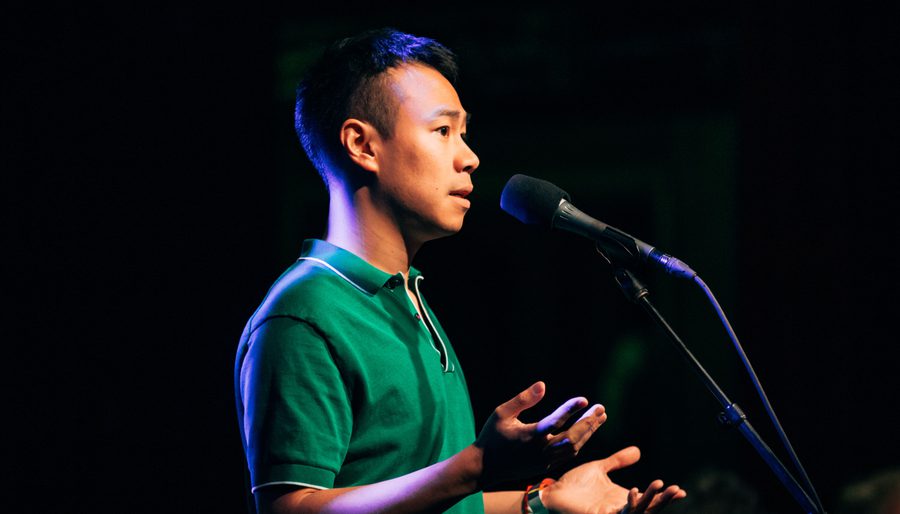
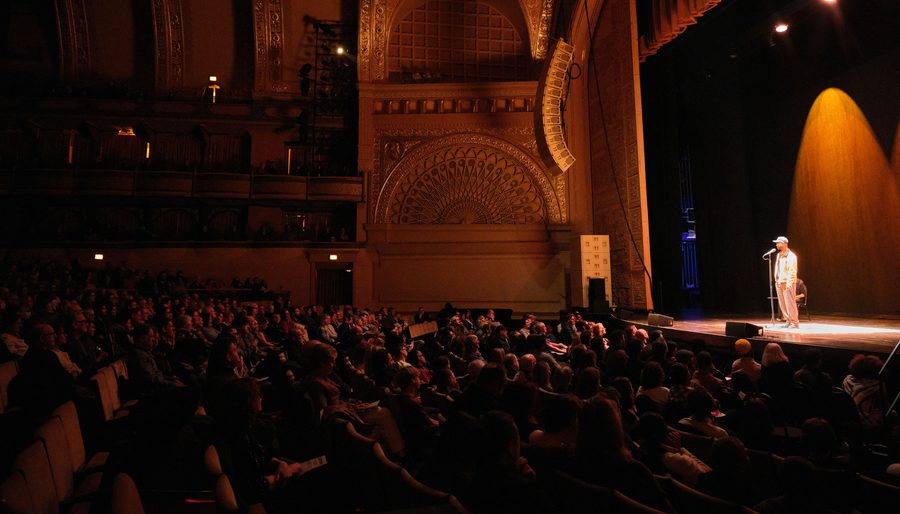


Jim Beam’s great-grandson describes growing up under the watchful eye of his famous Kentucky bourbon family.
“Your old man is the only guy that I know, that can have his wake and be at it too.”
Photo by David Kasnic

Transcript
Fred Noe — Booker and Me
I was born March 9th, 1957, Jim Beam’s great‑grandson. But being Booker Noe’s son became a hell of a lot bigger challenge than being Jim Beam’s great‑grandson. [audience chuckles] Now, to give you a little idea how my dad was, years ago he was in Chicago on a business trip. They were at a fancy restaurant, and he ordered a country ham entrée. They brought his lunch. The country ham did not meet his standards. Since Booker was a professional country ham curer, he told the PR guy with him, “Go out into the trunk of the car and get that ham I have got. [audience laughter] Bring it in here, and I’m going to show this chef what country ham is supposed to taste like.”
The PR guy says, “I don’t think they’ll let us bring food into this restaurant.” That perturbed my father quite a bit. He said, “Go get the damn ham.” [audience laughter] The PR man, knowing that my father would throw a fit, went to the car, got the ham, brought it back, put it on the table. Dad summoned the chef, and hell, he came out there, and he said, “Now, this is what country ham is supposed to taste like.” And he cut a slice and gave it to the chef. Later, he cut more slices and fed it to the patrons in the restaurant. [audience laughter]
Now, my dad was that critical of a chef he didn’t know. You can imagine how critical he was on me, on my life. My childhood and young adult life was a hell of a ride. Booker was bigger than life, he was a big influence on me, and we had some conflicts. He didn’t really appreciate my partying, my attitude, and a lot of other things. Our conflicts, they started, back when I was in grade school. In the seventh grade, I was sent to military school. They send all good kids to military school, right? [audience laughter] I spent my six years from seventh grade to high school.
When I was a senior, my dad said, “Well, you’ve done pretty good. Pick any college you want to go to. No problem. We’ll take care of it.” I said, “Okay, Pop. I was on scholarship. That sounds good.” Well, I’m looking around guys’ school. There’s a lot of Playboy magazines. I’m thumbing through Playboy magazine, and it says, “Top 10 party schools in the country.” [audience laughter] Ohio State was number one. Western Kentucky University down in Bowling Green [audience laughter] was number two. I read the article. I said, “Damn, I want to go to Western.” [audience laughter] Well, here it was close to home. I’m from Bardstown.
My mother, being the devout Catholic, going to church every morning, she wanted me to go to Notre Dame. Booker wanted me to go to University of Kentucky, because he started at UK, never finished. Jim Beam’s son, T. Jeremiah, and his daughter Mildred went to UK and graduated. So, I can remember going down to the payphone. Now, this was back in 1975 before everybody had cell phones in their pockets. Dropped a quarter in, made the collect call back home. Booker accepted charges. We chatted a little bit, and I declared where I wanted to go to college. I can remember he said, “You want to go where?” I said, “Western Kentucky University.” He said, “Why you want to go there?” Obviously, he knew the reputation of Bowling Green and the partying going on down there, but he went along with it.
Later that year, when he took me down there to school and dropped me off– You couldn’t have a car your first year, so he had to take me down and drop me off. As we’re carrying my stuff into the dormitory, they’re putting up a placard on the bulletin board: “Hundred‑keg beer party. All you can drink, five bucks.” [audience laughter] He looked at me and said, “I guess you’ll be there tonight.” [audience laughter] “Yeah, if I can find a ride.” [audience laughter] He looked at me and said, “Boy, you ain’t going to make it here.”
Three semesters later, I flunked out, [audience laughter] but I had a plan. I was going to intercept the letter when they threw me out, so he didn’t know about it, and I would ease the news to him. As my luck had it, the day the letter came, I was out with some of my friends, drinking a little bit, partying a little bit. That happened to be a day Dad came home early from work. He got the letter first. At dinner, Mom’s sitting there, and Dad, he comes up with a question, “Where are you going to college next semester?” ” Western.” “No, you’re not,” as he threw the letter across the table and it slid in front of my plate.
My life changed dramatically right then. [audience chuckles] He found me a job at his friend’s liquor store there in Bardstown, Toddy’s. He gave me six nights a week working, and Booker watched my every move. We still had conflicts, though. He never liked the length of my hair, he never liked the whiskers. We battled, battled, battled. That was just one of them things, fathers and sons. Fathers always want their sons to do better than they did. But after eight years and a lot of his money, I finally got out of college. [audience laughter]
My dad, he had one rule for me that he always stated. “If you want to come to work at Jim Beam, you’ve got to finish college. I didn’t finish, and you got to.” So, I finished. I was out. I was looking for a job. Booker looked at me, “Well, we don’t have a spot for you.” I said, “Okay.” Well, at that time, we were sponsoring a country music artist, Hank Williams Jr. I was kind of friends with Hank and the boys, and I’d been to several concerts, and they needed a road manager. Hank had fired him, and I stood in and helped them out. I remember going home telling Dad, I said, “I think I found me a job.” He said, “What’s that?” And I said, “Well, I’m going to go work for Hank.” He said, “Boy, that ain’t no life for me or you either.”
He’d been to a few concerts, he’d seen what the hell goes on at them things. Funny, the next week they had a job for me at Jim Beam. [audience laughter] Not a real glamorous job for Jim Beam’s great‑grandson, though. Night‑shift bottling‑line supervisor. [audience chuckles] I think it was a test to see if I’d grown up, if I could hold a job, or if I would even show up. Booker was still watching me. We hadn’t really gotten together too much. But they moved me around quite a bit. Whenever a supervisor was out, they’d stick me in. It didn’t matter, warehouse, whatever, cutting the grass. Somebody was gone, they stuck me in there. I did everything. And this went on.
But at the same time, Dad’s job changed, because he introduced the Booker’s bourbon and the small‑batch bourbon collection, our ultra‑premiums. He had to start traveling around a little bit. Well, actually, a lot. He traveled the world. He did this for a time. It was kind of wearing on him. Booker wasn’t real crazy about the lines at the airport. He wasn’t a very patient guy. The seats in the airplanes didn’t fit him. The hotel rooms, he wasn’t real crazy about sleeping in those beds. The three‑hour dinners really bummed him out. And that was his life. That’s what you do when you’re out there on the road promoting. I mean, you do that stuff.
] He’d come home from a long trip. He was about 70 years old. He’d been over to Japan. Hadn’t had a very good trip. We’re sitting out on the back patio there, having a little drink. And he said, “Well, man, I hated this trip.” I said, “What do you mean?” He said, “Well, they put me in this traditional Japanese hotel. I slept on the floor on bamboo mats.” Said “Wasn’t worth a damn.” I said, “Ooh.” He said, “The flight back, the seat didn’t fit, my back hurt, my hip hurt. Get back. Custom lines was forever. And top it off, they lost my damn luggage.” So, he was fed up. He said, “I’m done with this.” I said, “What do you mean you’re done? You can’t quit.” He said, “I’m not going to quit. I’m going to retire.” I said, “What?”
He said, “Think about it. Pro ballplayers, when they get to the end of their career, hell, they retire. Even racehorses, they retire them, too. That’s what I’m going to do.” I said, “Really?” He said, “It’s time for me to step aside, and you’re going to start doing this stuff.” I said, “What? Me?” I was working at the distillery down there. I wasn’t going on the road. He said, “I’ve talked to them in Chicago. They’re going to give you a shot.” So, I said, “Well, okay.” He picked up his glass, and he said, “You got to make people forget about me and think about you.” “Hmm. Okay.”
As he walked in, I’m sure my mouth was hung open, because all of a sudden, now, my ass was going to be on them planes flying around. And we did it, and I started doing it. Dad, his health started faltering a little bit on him in 2003. He had a little stay in the hospital, and he had to do some dialysis, his kidneys were malfunctioning a little bit. So, we had to travel back and forth between Bardstown and down here in Louisville for his dialysis treatment. During that 14‑day stay, I came and stayed here in the hospital with him. And on those rides back and forth, we did a lot of talking. It was kind of wild, because we talked about stuff we never talked about.
We talked about the bourbon industry, the way he saw it, what I was seeing. We talked about my son Freddie growing up, what he was going to do. We talked about everything. I guess you call it bonding, stuff that we never talked about when I was growing up. So, it was cool. On one of the rides, he got to tell me how proud he was of me. He’d been checking in with all the guys around the country, and they’d been telling, “Oh, Fred does a hell of a job. He might even be better than you.” I’m sure he didn’t like hearing that stuff. [audience chuckles] But I guess the deal was he was proud of what was going on.
Well, his kidney function was faltering a little bit, and he developed gangrene in his toe. But we brought him down here to the doctor down here at Jewish Hospital, and the same doctor had been treating on him. That doctor said, “Oh yeah, you got gangrene, Mr. Noe? We’re going to have to take that leg off.” Dad looked at that doctor, and he said, “Really? He said, “If I don’t let you take this leg off, how long am I going to live?” That doctor said, “Oh, that’s serious. it’ll spread, get in your body. Maybe a month.” He said, “Really? Okay.” he said, “Well, if I don’t let you cut this leg off and I quit doing this dialysis, how long am I going to live?” “Oh, that’s real serious. Maybe a week.” He said, “Really?
He said, “Well, Fred, take me on home.” He said, “I’m going to go out of this old world, Doc, with everything I come in with. I ain’t going to let you cut this leg off.” As we were going out the door, he said, “By the way, you can cancel that damn dialysis, too. I’m done with that.” Well, I got quiet. Wow, that’s a hell of a call. But we went on, got in the truck, we started driving back home, and Dad asked me, he said, “What you think about the decision I made?” I said, “Well, hell, Pop, it’s your ride. If you’re ready to jump off, that’s the way it goes. I mean, it’s your call.” He said, “Hey, boy,” and he said, “Quality of life means more than quantity of life. I ain’t having no fun.” “What the hell.” I said, “Well, okay, Pop.”
I answered the question, “Yes, sir.” And he got on me and said, “You don’t have to say ‘sir’ anymore.” “What the hell?” “We’ve been doing this all your life.” I said, “Okay.” Well, naturally, I said “sir” again from military school and growing up with him as a father. I mean, hell, that’s what you said. So, we got home and I called up my dad’s buddies and let them know the situation. I said, “You want to come see your old friend? Here’s what the Doc said.” So, a lot of them came by. They’d go in, come out, they might take a drink. They’d tell old stories. Some of them come out tears coming down their face.
One of his old buddies come out and said, “Your old man’s the only guy that I know that could have his wake and be at it, too.” [audience laughter] Booker lived about another two and a half, three weeks. He passed away in his sleep, peaceful. Everything was good. When we age the bourbon, we lose about 4% a year to evaporation. We call that the angel’s share. But when Dad passed away, I haven’t really put a pencil to it yet, but we’re probably losing 6% or 8% a year now. [audience laughter and applause]
I really didn’t know it, but my entire life, my dad was training me for what I’m doing today, but I didn’t have a clue. That was just his way of training me. I’m known as Jim Beam’s great‑grandson, but I’m proud to be [sobs] Booker Noe’s son.