

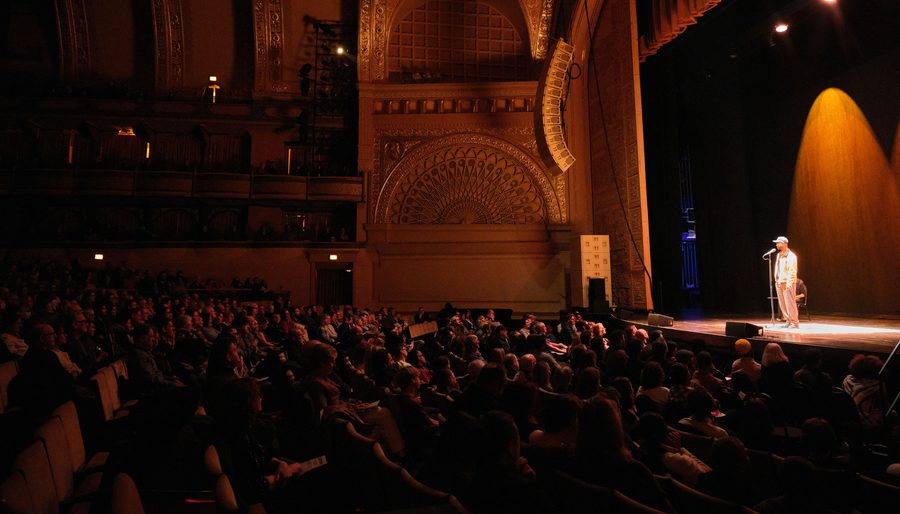



Corey Rosen adores his 80 year old Cousin Norman.
“Norman, out of nowhere, is like, 'I want to write an asshole monologue. About Shakespeake's assholes.'”
Photo by Noriko Shiota Slusser

Transcript
Corey Rosen — Cousin Norman
So, my story tonight is about my cousin Norman. Norman Wiener. Yeah, that’s his real name. So, Norman died. He died in August 1st. He died at the age of 82. It was unexpected. Even though he was 82– He wasn’t sick. He wasn’t dying. He didn’t know he was going to die. It wasn’t one of those, he’d been sick for a long time. It was just like he had this lump, and he went to get it checked out. It was kind of a routine thing. The doctor’s like, “We’ll take the lump out.” They took the lump out, the lump was fine. But the hole made an infection, and the infection made pneumonia, and pneumonia made no more Norman, which is really sad, because I was pretty close with Norman.
And being the designated person in my family, the West Coast representative, most of my family is back east, they designated that I was going to be the guy to tie up the loose ends. I was going to go to his apartment, go through the things, what was the stuff we’re going to keep or was the stuff we’re going to get rid of, salvage, that kind of thing. And that’s where I discovered Norman had a secret.
So, let me tell you a little bit about Norman first. Norman was a real character. Norman was very tall, which was a huge anomaly in my family. We’re all normal Jewish height, [audience laughter] sort of the cutoff, the 5’8”, 5’9” cutoff. And Norman was like 6’1/2” feet. He had giant glasses and giant ears and a giant nose, and he would tell these stories. [audience laughter] And “Oh, Corey, I got to tell you about this wonderful movie that I saw. It was called Seven, but it was so dark, Corey. It was dark dark. This is a dark movie. [audience laughter] When the movie was over, I was looking for my sunglasses. I had my sunglasses on, Corey.” [audience laughter] He would tell these stories about these things.
Norman was a teacher. He spent his life teaching English in high schools. And he never married. He never had a partner in his life. So, he traveled all by himself. He used the teacher schedule, and he would go on these long summer trips, and he was a frugal guy. He saved his pennies. He’d go on those Atlantic crossing transition repositioning cruises. You know what I’m talking about? Like, sort of cheap and staying at the hostels with the backpackers like an old guy, because he didn’t care. He didn’t care. It was like he was there. He loved theater. He loved Opera. He loved the arts, and he just took it in. He didn’t care about comforts, about staying on the concierge level at the Marriott. He didn’t care about those things. He cared about seeing things, like getting experiences.
But my whole family, like, a lot of people in my family all thought of him. They talked about uncle Norman, cousin Norman. They would say he was frugal. They would say, he’s a cheapskate. They would talk down about these decisions that he made in his life, which I thought was terrible, because I loved the guy. He would regale us with these stories, because he really loved theater. He would say, “Oh, I saw Lawrence Olivier, Corey. I was in at the Old Vic, and it was fantastic. He was Hamlet. Oh, it was incredible.” He remembered everything.
So, I did a show about 10 years ago called the [beep] Monologues. It was a charity for Crohn’s disease. [audience laughter] And Norman, out of nowhere, is like, “I want to write an [beep] monologue, Corey, about Shakespeare’s [beep]. There’s so many. Richard [beep]. Like, he wrote and he performed this thing. It was fantastic, and I loved it. Even on my son’s birthday, he shared it with Norman. They were one day apart. So, when my son Henry turned one, we had a 1st and 80th birthday celebration together. And it was awesome. He took the train up. It was the cheapest way to come up from Long Beach. [audience laughter] He slept in our guest room. It was really wonderful, and it was one of the last times that I saw Norman.
So, I’m in his apartment by myself. I let myself in and I’m cleaning out his apartment, and I have that weird moment, when you’re– I don’t know if any of you have ever had to do this thing. It was my first time where you’re there clearing out the stuff and deciding what to keep, what to lose, and I’m like, “Where’s the secrets?” Because I’m sad, but I’m also alone in somebody’s stuff. [audience laughter] It’s making me think about, what would it be like in my own house. Like, when I go, what’s the weird narrative that people are going to put together when they see my 400 snow globes [audience laughter] and my box of random pictures and that little tiny bag of hash in the freezer? [audience laughter] All those things that you just have and how you like, “Oh, that’s important. That’s not important.” The experience was really overwhelming, and so I packed up the car.
I skipped my flight. I was supposed to fly home, but I just packed up this rental car and I drove all the way at dawn. I spent about 20 hours in his apartment clearing out the stuff. When I got home, I looked through all these carousels of pictures that he had taken. He traveled to dozens of countries. He had passports, 10 passports, filled with visas and stamps and all this stuff. I got to see his life through his pictures, through his eyes. The trips that he took, it was so overwhelming to see. They weren’t pictures of him in front of stuff. It was just what he saw. They were bad pictures [audience laughter]. They’re pictures that when you get off the tour bus, you take. But it was really emotional.
And then, I read the will, and that’s where the secret was, because it turns out that Norman was loaded. And I was in the will. [audience laughter] All my [beep] family who had written off cousin Norman, the cheapskate, — [audience cheers] — the frugal cheapskate, who were never nice to Norman. I didn’t want anything from Norman, I just loved him. I loved who he was and how he was. Norman didn’t want to die. He didn’t plan to die. He had enough money for 20 years of luxury travel, but he was saving it and he gave it to my family. And now, my kids can go to college, and I miss him. So, thank you.