



A character actor shares the backstory of a pivotal scene in a classic movie.
Storyteller
Featured on
Recorded Date
“Experimental theather, it exists outside the laws of supply and demad. There is only supply.”
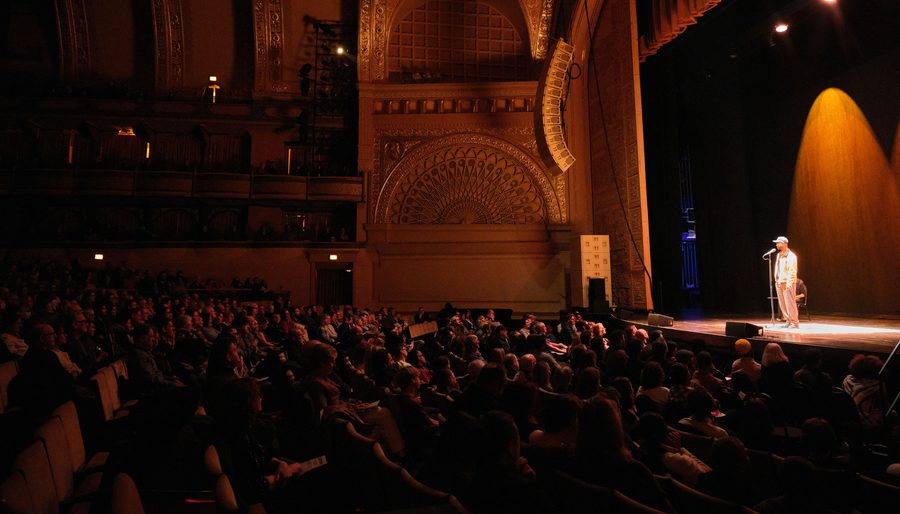
Photo by Jason Falchook

Transcript
Josh Broder — Cut
It’s the late 1980s, and I’m in my early 30s and I’m a lead actor in a hot downtown New York theater company. In those ice-cold rehearsal halls and those dank basement theaters, I am all powerful. [audience chuckle] I trust my instincts. I make big choices. I surprise the hell out of my audience. Coming to our shows is like coming to a wild party. And to some extent, I am the party. [audience chuckle]
You know, but downtown theatre is a very small world. A corporate friend of mine once told me that he liked to impress first dates by bringing them to our shows because, “You guys are so funny, you’re so smart, and no one’s ever heard of you.” [audience laughter] Now, when your claim to fame is, “No one’s ever heard of you,” there are financial implications. [audience chuckle]
In a good week, my company can pay me $125. And even a quarter century ago in New York City, that’s abject poverty, and abject poverty is wearing thin. Two o’ clock in the morning, end of a 15-hour tech rehearsal day, the thought that I could get into a cab, a taxi for the short ride over the Brooklyn Bridge to my house, that’s $10. It’s not in the equation. It’s down into the subway and hope for the best, which sucks. Now, I don’t want to give up the fun. I don’t want to give up the party, but I need some money. And that means film or television. I’m not looking to be a star. I just want to be able to take a taxi every once in a while. And you know, it’s not just money in terms of a paycheck.
Experimental theater, it exists outside the laws of supply and demand. [audience chuckle] There’s only supply. [audience laughter] There’s no demand. And for whatever reason, I want to test myself out in the marketplace. I want to see if my work has value. I want to see if I can even do what I know how to do when money is on the line. But it’s a long way from an illegal fire trap theater to Hollywood.
But then the film director, Jonathan Demme becomes a fan of my company. Now, I love Demme’s movies. I’ve been into Demme all the way back to Melvin and Howard. I would love to be in a Jonathan Demme movie. And this could also be a gateway opportunity. He put a downtown friend of mine into Married to the Mob. The guy got a great agent. Three months later, he’s on Miami Vice getting eaten by crocodiles. [audience chuckle] And sure enough, when Demme starts casting his next movie, he puts a couple guys from my company into it, but not me. Well, it’s crunch time, so I gin up the nerve and I ask Jonathan Demme for a part in his next movie. And true to his generous nature, Jonathan comes through, but the seeds of doubt have been planted.
I mean, downtown, I am the party. Here, I wasn’t even invited to the party. I’m pretty much crashing the party. But, you know, screw it. I got a part. I’m thrilled. So, start reading the script. What is this? Jonathan Demme’s doing a horror movie about a serial killer? What is this thing? Look at the cover, The Silence of the Lambs. What do I know? It could be good. [audience chuckle] But what’s my part? I keep reading. Oh, okay. I play an EMT and whoa. I get killed in the back of my ambulance by Anthony Hopkins as Hannibal Lecter. [audience laughter] If I can pull this off, it’s going to be great, if – .
Fly out to the location, Pittsburgh. Take a taxi to a very nice hotel. Intimate dinner that night at the house they’ve rented for Jonathan. Demme, his wife, the artist, Joanne Howard, his producing partner, cinematographer, me and Anthony Hopkins, who I end up seated next to. From his questions, you can tell the guy knows nothing about Jonathan Demme. This was supposed to be just a couple weeks work and a busy year. But he tells me that only a fool would try to judge a film by the dailies. But I must say, they’re looking awfully good. And I’ve never had so much fun on a set.
Well, you know, I haven’t even seen the set, but so far, I’m having a great time. [audience laughter] And I keep telling myself that pulling off a conversation with Anthony Hopkins isn’t the same thing as pulling off a scene with Anthony Hopkins. But so far, I’m doing great. [audience chuckle] Well, they’re filming at night and the first couple of those nights, I’m really an overpaid extra. I’m riding shotgun in my ambulance and hurrying the gurney inside. And then comes the night of my first real scene. Not my scene with Hopkins, but the first scene where I speak. My crew of extras huddles around this apparently injured cop while I shout orders and the camera whirls around us. I feel loose, focused, committed to the imaginary circumstances. I mean, it turns out to be easy to pretend when they make it so real. The guy looks like hell. His face is shredded to bits.
Take one. I rock. Take two. Even better. Take three. Trust my instincts. Make the big choice. I throw in an R‑rated improvisation. Buzz. “I need the [beep sound] oxygen.” Cut, print. Wrap for the night. Demme gives me a big bear hug. [audience chuckle] Shredded face guy high-fives me. [audience laughter] The crew wrapping up has adopted my profane improvisation. “Jill, I need the [beep sound] gaffer’s tape.” [audience laughter] This is like downtown, only with a fat paycheck and all the food you can eat. I am the party. [audience laughter]
Flash forward a couple nights, my last night on the set. My big scene with Hopkins. Now, spoiler alert, are you ready? It’s not a cop in the back of the ambulance. It’s Hannibal Lecter wearing the uniform and face of the cop that he’s killed. Now I say it’s my big scene, but to the crew, my scene is the thing to get out of the way. The real business of the night is the stunt driving with the ambulance. That’s going to take some time.
Now, there’s only one interstate that tunnels through the mountains and into downtown Pittsburgh. And they have closed that interstate at the mouth of the Fort Pitt tunnel. We have from the end of rush hour in the evening to the beginning of the rush hour in the morning to get my scene out of the way, do the stunt driving, get packed up, and get the hell out of the way so Pittsburgh can get to work in the morning. And I feel ready. Ready to end on a high note. But setting up takes hours longer than it should. It’s almost midnight before they even start to think about my scene. And that’s when someone realizes that my speech– it’s a few sentences of medical lingo shouted into a radio microphone while Hannibal Lecter rises behind me. It’s short, but the shot, the movement of the camera, Anthony Hopkins’ business is long. They need more words for me to say. And all eyes turn to a guy on the periphery of the set.
He’s a local guy with a medical background. He’s rented them the ambulance for the night. And I see his face light up. This is his chance to write a line for a Hollywood movie. Now he’s the party. And I know I’m not going to have any fun at all. Guy scribbles out three pages of tongue-twisting medical gibberish. “Post-ictal with lactated Ringer’s running on a double IV. Viscous evisceration.” On and on and on. And I’m handed these three pages and I’m told to memorize them fast. And I do.
But practicing in my trailer, I can speak them with Ali Alon about Bar Mitzvah boy who’s blown off his Hebrew studies till the morning of the big day. [audience chuckle] We haven’t shot a single frame and I am screwed. Dead man walking from my trailer to the ambulance. My new friends on the crew shout encouragement. “One take, Josh. One [beep sound] take.” Clock is ticking. There’s a midwinter thaw and the temperature has spiked to near 70. The evaporating snow has condensed into a thick fog. I climb into the back of the ambulance and dropped down on the bench with the film lights. It’s at least 90 degrees in here, equally humid. Hopkins is escorted in and laid out on the gurney, silicon mask in place. They start ladling chopped-up SpaghettiO viscera onto his face. [audience chuckle] This hellhole instantly takes on the ripe stench of an elementary school cafeteria. [audience laughter]
Take one. Action. It’s a disaster. I mean, I get the words out barely, but worse, you can see my eyes scanning the scribbled pages that I’m visualizing in front of me. Cut. Reset. It takes 20 of the night’s precious minutes to redo Hopkins’ makeup. I’m starting to panic. I got to get out of this ambulance. I need to breathe. I got to go back to Manhattan where I belong. But every escape route is blocked. Hopkins and the makeup guys, the camera, the lights. I cower in there like a cornered animal. Everyone but me. Ready for take two.
Demme calls in. “Just drive the speech, Josh. Just spit out the words.” And I try to spit out the words, but mostly I just spit. [audience chuckle] Cut. Reset. My heart is pounding and my brain starts to take up its rhythm. “You blew it, you’ll blow it.” “You blew it, you’ll blow it.” And I do. In place for take four. Hopkins asks, “Might I speak to Jonathan a moment?” [audience chuckle] Demme squeezes his head painfully between the camera and the door frame. “Are we going to be much longer at this? I am feeling a bit claustrophobic, and this goo is making me nauseous.” Anthony Hopkins is unhappy.
When take four still shows room for improvement, Demme goes into crisis intervention mode, chopping out big chunks of my speech, while the cinematographer unhappily dumbs down this pivotal shot that pays off the entire escape sequence. But the problem with taking out chunks of a speech I barely know is it only muddles me more. Take five is my worst yet. Take six. Cut. Take seven. Cut. Take eight. Cut. Waiting for take nine, I start thinking about the Pittsburgh commuter. [audience laughter] I have no idea what time it is. Is he awake? Is he headed for his car? Is he headed for my tunnel?
Take nine. Action. And something in me snaps. Midway through the speech, I’m shocked to suddenly hear myself wail. “Jonathan.” Now, of all the highly successful people I know, Jonathan Demme is far and away the kindest. But now I’ve forced him to try out tough love. “Keep rolling. Just do it, Josh.” Bam. And he slams the high side of the van hard. And it works. Take nine, continued. Goes a little bit better.
Take 10, even better. For take 11, they reinstitute my full speech and the full complex shot. And my brain resets to accommodate the new information. Take 11. Action. And I am in roll. Medical language I’ve used for years fires from my lips [audience laughter] as I stare through a windshield I can’t actually see. Instinct tells me that something is amiss with my patient, and I whip around to find him sitting up with a new face. No lacerations, but drenched in blood. He holds a knife to my throat. We stare at each other. No one says cut. I can hear the camera motor still whirring. No words. But I look him a question. “What’s happening?” Hannibal Lecter looks me in answer. “I’m going to eat you.” “Do you have to?” [audience chuckle] “Oh, yes.”
A great wave of sorrow washes over me, and Hannibal Lecter laps it up. I’m acting with Anthony Hopkins [audience laughter]. Outside the van on a small monitor, Jonathan Demme watches with pleasure. For these few moments, we three are the party. Thank you.